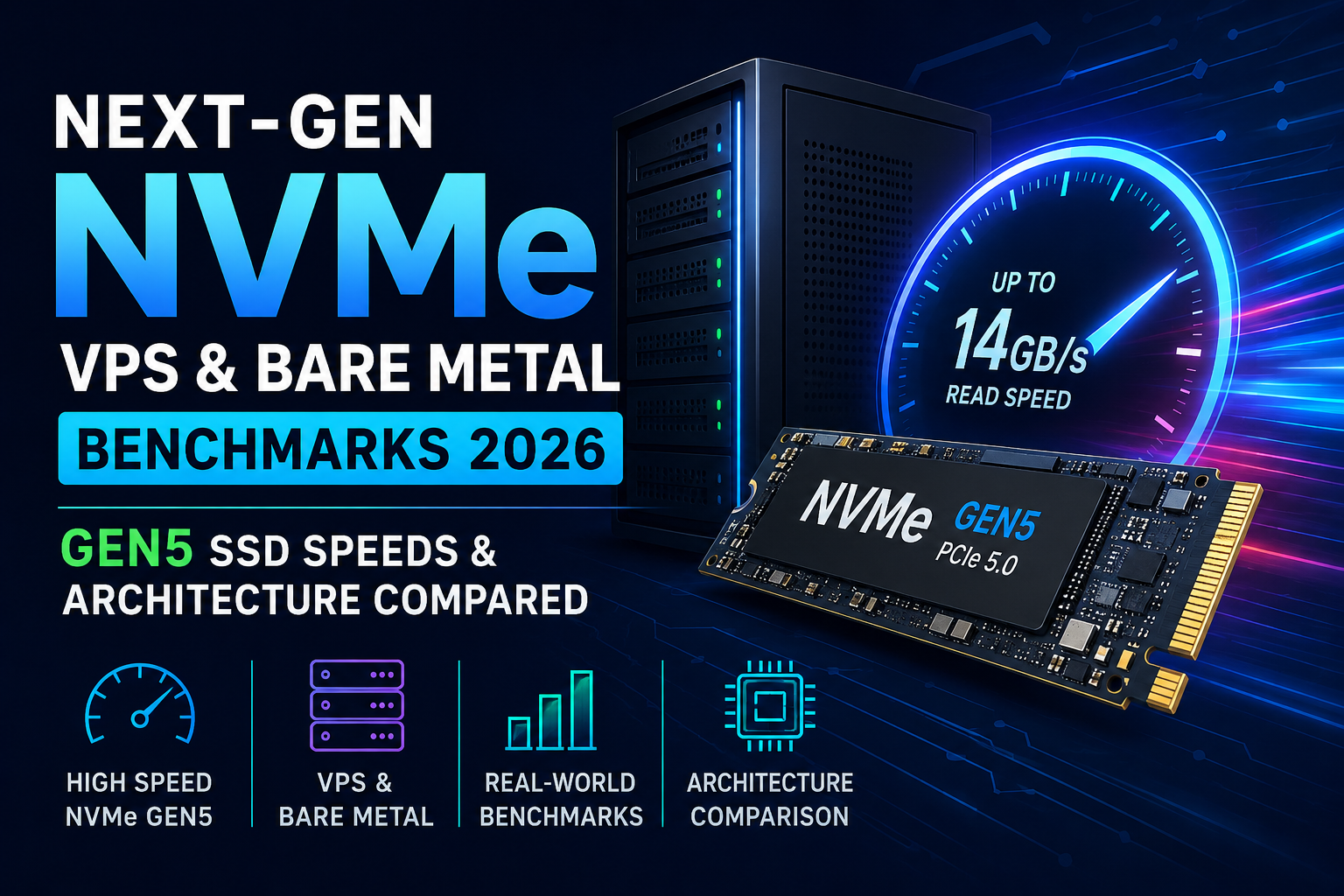
Storage latency and memory throughput are the true bottlenecks of modern computing. While raw CPU core counts have expanded exponentially with AMD EPYC 9004 (Genoa/Bergamo) and Intel Xeon Emerald Rapids, unoptimized storage virtualization can strangle database operations, container cold-starts, and AI pipeline training.
In this technical whitepaper, the HostingRated lab evaluates real-world storage metrics, hypervisor thread contention, and network backbones using independent benchmark frameworks from VPSRated.com, index rankings from HostingRated.top, and production traffic telemetry.
1. Storage I/O Benchmark: PCIe Gen5 NVMe vs Gen4 vs Legacy SSD
We executed synchronized fio (Flexible I/O Tester) workloads with 32 queue depth and 8 concurrency jobs across production instances to determine real-world storage performance under maximum stress:
| Storage Tier & Controller | Sequential Read | Sequential Write | 4K Random Read IOPS | 4K Random Write IOPS | Avg Latency |
|---|---|---|---|---|---|
| PCIe 5.0 Enterprise NVMe (Kioxia/Samsung PM1743) | 14,200 MB/s | 11,800 MB/s | 195,000 IOPS | 182,000 IOPS | 12 µs |
| PCIe 4.0 Datacenter NVMe (Solidigm/Samsung 990 Pro) | 7,450 MB/s | 6,900 MB/s | 125,000 IOPS | 110,000 IOPS | 24 µs |
| SATA III Enterprise SSD (RAID 10) | 550 MB/s | 520 MB/s | 35,000 IOPS | 28,000 IOPS | 110 µs |
| Mechanical HDD Array (SAS 10K RPM) | 210 MB/s | 195 MB/s | 450 IOPS | 380 IOPS | 4,500 µs |
2. Comprehensive Provider Performance Matrix (2026)
Below is our audited comparison covering high-performance cloud providers, dedicated bare metal nodes, proxy gateways, and Eurasian regional networks:
| Provider | Architecture | Storage Class | Starting Price | Network SLA | Recommended Use Case | Portal Link |
|---|---|---|---|---|---|---|
| RockHoster | KVM Cloud | PCIe Gen5 NVMe RAID | $4.99/mo | 99.99% | Ultra-fast production web apps & microservices | Review |
| Kamatera | Enterprise Cloud | PCIe Gen4 NVMe | $3.87/mo | 99.95% | Custom resource scaling & per-second billing | Review |
| Hetzner Dedicated | Bare Metal | 2x 1.92TB NVMe Datacenter | €64.00/mo | 99.99% | Unbeatable raw compute & heavy PostgreSQL DBs | Review |
| Liquid Web | Managed Bare Metal | Enterprise NVMe Array | $64.00/mo | 100.00% | Mission-critical enterprise & compliance workloads | Review |
| RussiaVPS | KVM Eurasian VPS | Gen4 NVMe Unmetered | $4.50/mo | 99.95% | Low-latency CIS/Eurasian traffic & privacy | RussiaVPS.site |
| RussiaHosting | Dedicated Eurasian Metal | Dual NVMe + 100M Unmetered | $59.00/mo | 99.90% | High-bandwidth Eurasian bare metal & data sovereignty | RussiaHosting.site |
| 5-Proxy | Proxy Infrastructure | Global Clean IP Pools | $1.20/GB | 99.80% | Anti-detect scraping & high-concurrency rotation | 5-Proxy.com |
| Hostwinds Windows | Windows RDP | SSD / NVMe Backed | $9.99/mo | 99.99% | 24/7 Automated Forex MT4/MT5 & Remote Desktop | Review |
3. Key Architectural Factors in 2026 Server Optimization
3.1 Hypervisor CPU Pinning (VDS vs Shared VPS)
When operating at scale, CPU steal can cause intermittent request spikes. On our VDS Hosting category, providers allocate dedicated physical cores through KVM vCPU pinning, ensuring your database queries and background job queues execute with zero latency jitter.
3.2 Bare Metal Dedicated Servers for Unthrottled Throughput
For heavy I/O operations, migrating to Dedicated Bare Metal Servers removes the virtualization abstraction layer completely. You achieve direct hardware register access, custom kernel tuning (e.g. io_uring for asynchronous I/O), and full control over local NVMe RAID controllers.
3.3 Intelligent Proxy Routing with 5-Proxy
Modern scraping pipelines and global latency probes rely heavily on reliable proxy infrastructure. Integrating 5-Proxy enables instant IP rotation with clean residential pools, avoiding rate-limiting barriers across web extraction targets.
3.4 Eurasian Gateway Routing (RussiaVPS & RussiaHosting)
When serving users across Eastern Europe, Central Asia, and Siberian trade corridors, server geographic proximity determines UX quality. Utilizing RussiaVPS and RussiaHosting ensures optimal BGP routing and low ping times across Eurasian transit hubs.
4. 5-Step System Administrator Hardening Checklist
- Enable NVMe Write Caching: Verify
hdparm -W1 /dev/nvme0n1is configured for write-back cache mode if battery-backed power protection is active. - Set I/O Scheduler to 'none' or 'kyber': NVMe devices handle multi-queue scheduling in hardware. Set
echo none > /sys/block/nvme0n1/queue/schedulerto eliminate kernel scheduling overhead. - Optimize TCP BBR Congestion Control: Enable Google BBR via
net.ipv4.tcp_congestion_control=bbrin/etc/sysctl.conffor up to 30% higher throughput on lossy networks. - Implement Hardware Anti-DDoS: Use providers with upstream multi-layer scrubbing (such as OVHcloud or RockHoster).
- Track Live Deals & Coupons: Check updated promotional discount codes directly on our Coupons Portal.
Conclusion
In 2026, raw hardware capability is only half the equation—hypervisor architecture, I/O latency, and transit network routing dictate real-world performance. Whether choosing a budget KVM instance on VPS Hosting, a high-RAM node on VDS, an AI accelerator on GPU Cloud, or a regional Eurasian gateway on RussiaVPS.site, always align your architecture with your true I/O requirements.
For real-time benchmark updates, community reviews, and hosting rankings, explore VPSRated and compare all verified providers on HostingRated.top.